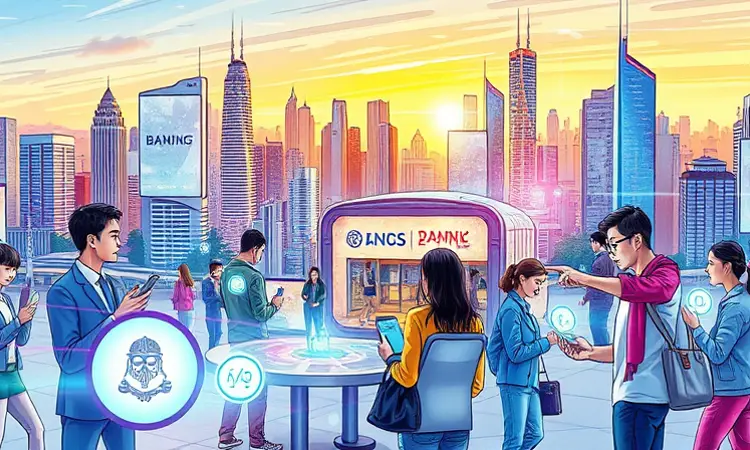
Traditional bank lobbies fading into memory, consumers increasingly rely on digital channels to manage finances. With a global digital banking market size projected at $20.43 billion in 2025 and soaring to $43.73 billion by 2033, the industry’s trajectory is unmistakable. Across North America, Europe, and Asia Pacific, financial institutions are racing to adapt—or risk obsolescence as customer expectations shift at unprecedented speed.
This article delves into the driving forces behind this revolution, examines the cutting-edge technologies reshaping services, and explores how branches will evolve in a world where convenience and personalization reign supreme.
Market Expansion and Growth Trajectories
Digital banking’s rise is fueled by robust adoption metrics and clear economic incentives. Net interest income from digital banks is expected to climb from $1.61 trillion in 2025 to $2.09 trillion by 2029, reflecting a compound annual growth rate (CAGR) of 6.8%. Meanwhile, North America holds 37.7% of the market, Europe 26.9%, and Asia Pacific 22.9%, led by China’s 35.37% regional share.
In the US alone, nearly 216.8 million users will access digital banking by 2025. Such numbers underscore why banks of all sizes are accelerating efforts to capture shifting consumer dollars.
Driving Forces Behind Digital Adoption
Several interrelated factors propel customers toward apps and online portals. Foremost is digital-first, mobile-driven customer expectations, especially among Millennials and Gen Z, who demand instant access and intuitive design. Concurrently, financial institutions realize that eliminating brick-and-mortar overhead reduces operational costs, enabling reduced fees and competitive interest rates.
- Convenience and frictionless experiences
- Lower fees through reduced branch networks
- Rise of neobanks offering agile, customer-centric services
- Heightened emphasis on personalization and instant support
As legacy banks and fintech challengers vie for market share, agile players that anticipate and respond to consumer needs will define the competitive landscape.
Emerging Technologies Redefining Banking
Technological innovation is the engine driving digital banking’s evolution. Artificial intelligence stands at the forefront, with estimates indicating that 75% of banks managing over $100 billion in assets will have fully integrated AI strategies by 2025. AI not only delivers AI-powered fraud detection and prevention—potentially cutting fraud by up to 50%—but also powers personalized financial advice, real-time risk scoring, and automated customer support.
- Automation and open APIs for rapid feature deployment
- Biometric real-time identity validation replacing outdated PINs and passwords
- Embedded finance integrating banking into non-financial platforms
- Generative AI modernizing legacy codebases and product innovation
Moreover, the Internet of Things promises to connect everyday devices—wearables, home assistants—to banking platforms, generating data that supports predictive analytics and tailored services.
The Evolving Role of Physical Branches
Despite the digital onslaught, physical branches remain critical touchpoints for complex transactions and trust-building interactions. However, their form and function are shifting dramatically. Many banks are closing underutilized locations, while reimagining retained branches as advisory hubs or digital experience centers rather than traditional teller lines.
Hybrid strategies are emerging, combining the ease of digital channels with strategic, relationship-focused branch footprints. Customers still value face-to-face guidance for matters such as mortgage approvals or wealth management, underscoring the need for a balanced omnichannel approach.
Challenges and Strategies for the Next Decade
Transitioning to digital dominance is not without its hurdles. Cybersecurity threats escalate as online activity grows, evidenced by over 20,000 cyberattacks on financial institutions in 2023 that resulted in $2.5 billion in losses. Regulatory compliance across diverse jurisdictions further complicates the integration of open banking models and data-sharing initiatives.
- Modernizing legacy tech stacks while ensuring stability
- Balancing automation with the human touch to maintain trust
- Investing in AI-driven security frameworks and privacy safeguards
Success will hinge on banks’ ability to innovate with agility, adopting platform migration to cloud-based architectures and fostering cultures that embrace continuous transformation.
Looking Ahead: Visions for 2030 and Beyond
As we approach 2030, several forward-looking themes will come to define digital banking’s next chapter. The concept of platformification will see banks functioning as orchestrators of customized financial and non-financial services, seamlessly delivered across ecosystems. Biometric security will become ubiquitous, offering universal, real-time identity verification at every digital touchpoint.
Universal financial accessibility will broaden, as AI-driven tools empower underserved communities with budgeting insights and micro-loans. Data monetization strategies may evolve, with banks offering anonymized customer insights to partners under strict privacy standards. Ultimately, the entire banking lifecycle—onboarding, transactions, lending, support—will converge into a single, seamless journey tailored to individual needs.
In this unfolding future, banks that master personalization, uphold trust, and invest strategically in emerging technologies will lead. The branch may no longer dominate the skyline, but the human connections it represented will endure through digital channels that are smarter, more empathetic, and infinitely more accessible.
The journey beyond the branch has only begun. By embracing innovation and centering customer experiences, financial institutions can craft a future where access is universal, services are personalized, and the promise of digital banking is fully realized.