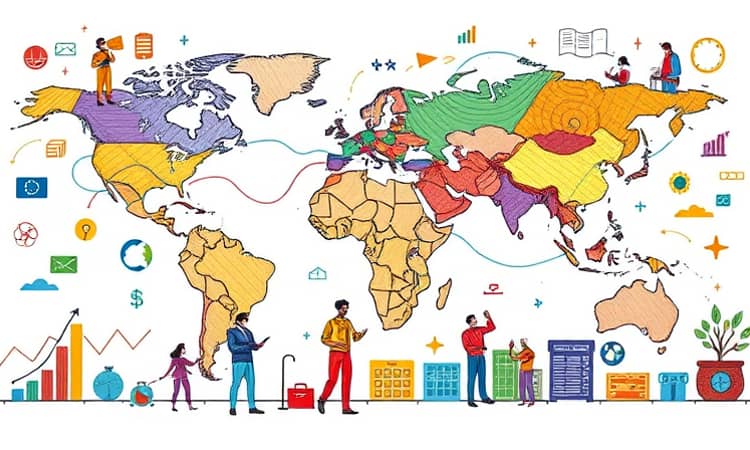
In a world of shifting paradigms, understanding the forces that shape global markets in 2025 is more critical than ever. This article explores the slowing yet resilient growth landscape, the pressures of geopolitical tensions, and the promise of technological transformation. By illuminating key drivers and offering practical strategies for success, it aims to empower policymakers, business leaders, and investors to navigate uncertainty with confidence.
A Slowing Yet Resilient Growth Landscape
Projections for global GDP growth in 2025 range from 2.3% to 3.2%, reflecting the divergent methodologies of leading institutions. The World Bank’s forecast of 2.3% contrasts with the IMF and OECD estimations of 3.2%, while the UN and PwC anticipate 2.4% and 2.6% respectively.
These variations underscore the complex interplay of regional dynamics and external shocks. Advanced economies may hover around 1.5%, whereas emerging markets, led by India and China, could achieve growth rates above 4%. This uneven pattern highlights both the challenges and opportunities in a fragmented global economy.
For investors, these divergent forecasts emphasize the importance of diversified portfolio allocation. Allocating capital to high-growth regions while maintaining stability in developed markets can optimize risk-adjusted returns.
- World Bank: 2.3% in 2025
- IMF & OECD: 3.2% in 2025
- UN: 2.4% in 2025
- PwC/Oxford Economics: 2.6% in 2025
Business leaders must calibrate their strategies to this dual narrative of constraint and possibility. Identifying sectors where demand remains robust, from healthcare to green energy, can unlock new growth even in subdued environments.
The Geopolitical Context
From the Ukraine conflict to US-China competition and Middle East volatility, geopolitical tensions are casting long shadows over markets. Energy prices, supply chains, and capital flows are increasingly influenced by diplomatic standoffs and security concerns.
For businesses and investors, staying informed about shifting alliances and sanctions regimes is vital. Scenario planning and supply chain diversification can mitigate risks and unlock new avenues for growth, even amid rising protectionism.
Governments are also recalibrating defense and trade budgets, creating pockets of opportunity in defense technology and critical mineral supply chains. Stakeholders who monitor policy debates can anticipate sectoral winners.
Trade in a Fragmented World
Global trade, once the engine of growth, faces headwinds from tariffs, export controls, and reshoring initiatives. Protectionist measures are reshaping traditional supply routes, while frontloading and stockpiling punctuate trade activity.
Adopting an agile approach to procurement and logistics can turn fragmentation into a competitive advantage. Companies that embrace digital platforms and local sourcing networks position themselves to respond swiftly to policy shifts.
Investment in digital trade infrastructure, such as blockchain-enabled tracking and AI-driven demand forecasting, can enhance transparency and reduce transactional frictions. This digital layer is becoming indispensable for future competitiveness.
- Diversify supplier base across regions
- Invest in digital supply chain visibility
- Explore nearshoring and regional partnerships
- Implement agile risk management frameworks
Monetary and Fiscal Policy Balancing Act
With inflation generally receding, central banks in many regions are exploring rate cuts to support growth. Yet, elevated public debt levels, especially in emerging markets, constrain aggressive easing. Policymakers must balance debt sustainability with growth mandates.
Fiscal consolidation efforts aim to reduce deficits, but tight budgets can hamper critical investments in infrastructure and social programs. Observing policy signals and positioning portfolios accordingly will be essential for risk-adjusted returns.
Global financial conditions remain sensitive to sudden shifts in sentiment, raising the specter of market corrections. Risk managers should build in stress tests that account for tightening credit spreads and currency volatility.
Technological Shifts and the Future of Work
Artificial intelligence, automation, and digital platforms are redefining productivity across sectors. While these disruptive technologies promise efficiency gains, they also introduce volatility and skill mismatches in labor markets.
Embracing lifelong learning and reskilling initiatives is no longer optional. Workers and organizations that foster digital literacy and adaptability stand to benefit from rising demand in new tech-driven industries.
Bridging the digital divide is critical to ensure inclusive growth. Public-private partnerships in education can accelerate access to high-speed internet and cutting-edge training programs, fostering a more equitable workforce transition.
- Invest in continuous skills development
- Adopt flexible and hybrid work models
- Partner with educational platforms for upskilling
- Encourage cross-functional team collaboration
Embracing Sustainable and Inclusive Growth
Aligning economic objectives with environmental and social goals is crucial for long-term stability. The UN’s Sustainable Development Goal 8 underscores the need for decent work and economic inclusion, particularly in developing regions beset by debt and pandemic aftereffects.
Embedding sustainability into corporate strategies can unlock new markets and enhance brand resilience. Green technologies, circular economy models, and impact investing are reshaping capital allocation toward more equitable outcomes.
Strong policy frameworks and incentives, such as carbon pricing and renewable energy targets, can accelerate the transition. Companies that lead in environmental stewardship often gain market leadership and consumer trust.
Practical Steps for Navigating 2025 and Beyond
In an era of intersecting risks and opportunities, proactive strategies will define success. By anticipating policy trends, embracing technology, and prioritizing sustainability, stakeholders can craft resilient pathways forward.
- Monitor key macro indicators and policy announcements
- Implement flexible supply chain and risk frameworks
- Invest in workforce development and digital infrastructure
- Align portfolios and projects with ESG principles
- Engage in cross-sector collaborations for innovation
Adopting a mindset of continuous learning and agile decision-making can transform uncertainty into a catalyst for creative problem-solving. Organizations that foster a culture of adaptability will lead the next wave of global growth.
As the global economy navigates a period of slower growth and structural change, those who blend foresight with adaptability will thrive. By understanding the forces shaping markets in 2025, individuals and institutions can foster sustainable prosperity and resilience in the face of uncertainty.
Ultimately, the ability to read the economic currents, harness innovation, and commit to inclusive progress will determine who emerges stronger in this new chapter of global development.