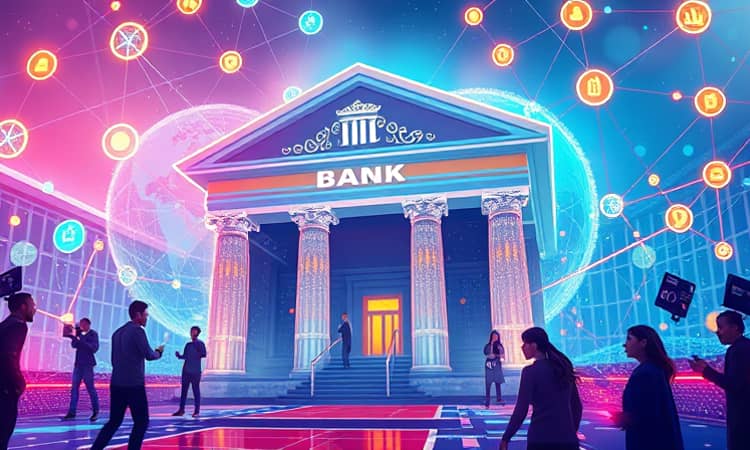
Banking is undergoing a seismic shift as distributed ledger technology remakes the financial landscape. From multi-trillion-dollar projections to real-world deployments, blockchain is emerging as the foundation for the next generation of banking services.
In this article, we examine the market drivers, key benefits, regulatory trends, and future vision that define a blockchain-powered bank.
Market Landscape and Growth Projections
The global blockchain market is on an unprecedented growth trajectory to 2030, with analysts forecasting a value of $1.43 trillion by the end of the decade at a CAGR of 90.1%. Within banking and financial services, spending is estimated at $10.65 billion in 2025, surging to $58.2 billion by 2029 at a CAGR of 52.9%. Financial institutions alone invested $552 million in blockchain initiatives during 2025, underscoring the technology’s rising strategic importance.
These figures reflect a broader adoption wave: by 2025, over 80% of Fortune 500 companies leverage blockchain in some capacity, while 90% of US and European banks are piloting production use cases.
Driving Adoption Across Institutions and Retail
The banking sector constitutes more than 20% of global blockchain deployments, making it the leading adopter worldwide. Technology leadership teams at banks (74%) view blockchain as a major business opportunity and competitive differentiator.
On the retail front, active blockchain wallets numbered 83 million in 2025, and total cryptocurrency users reached an estimated 861 million—about 10.8% of the world’s population. Retail transactions jumped by 125% from January–September 2024 to the same period in 2025, with India, the United States, Pakistan, the Philippines, and Brazil leading adoption.
Transformative Benefits in Banking
- Removing single points of failure through decentralization.
- Real-time global payments and settlements for cross-border transfers.
- Robust auditability and compliance mechanisms via transparent ledgers.
- Programmable money and smart contracts to automate agreements.
- Self-sovereign digital identities to streamline KYC and onboarding.
Key Use Cases Accelerating Innovation
Blockchain’s versatility spawns diverse banking applications, each offering quantifiable value:
Cross-Border Payments and Stablecoins
Blockchain is disrupting traditional payment rails like SWIFT, enabling frictionless international money transfers at lower costs. Stablecoin supply soared from $5 billion in September 2020 to $305 billion by September 2025, illustrating massive traction for remittances and value preservation. Major banks now issue stablecoins, while central bank digital currency pilots are gaining momentum.
Navigating Regulatory Currents
Regulatory clarity is key to fueling institutional participation. In the US, landmark legislation in 2025—such as the GENIUS Act for stablecoins, the CLARITY Act on market structure, and the White House’s Digital Assets Report—has driven crypto transaction volume up 50% year-over-year (exceeding $1 trillion Jan–Jul 2025). Globally, G20 nations are harmonizing rules, attracting capital, and encouraging innovation, even as crypto crime losses reached $2.1 billion in H1 2025.
Building the Next-Gen Bank
- Frictionless account creation with on-chain onboarding.
- Instant international transactions leveraging tokenized rails.
- Programmable finance for loans, insurance, and derivatives.
- Automated back-office workflows and on-chain auditing.
- Real-time risk monitoring and low-cost compliance.
Barriers to Overcome
- Interoperability challenges between legacy systems and multiple blockchains.
- Scalability limitations on early public networks.
- Fragmented regulatory frameworks across jurisdictions.
- Market volatility and risk management concerns.
Future Outlook
By 2030, blockchain underpinnings will power banks offering seamless digital experiences and programmable services to customers worldwide. As retail adoption climbs and institutional inflows continue—highlighted by $15 billion in Spot Bitcoin ETF investments in H1 2025—the blueprint for a Next-Gen Bank takes shape. Embracing decentralization, transparency, and automation, banks will redefine trust and efficiency for the digital age.
For financial leaders and innovators alike, the time to build on this blockchain backbone is now.