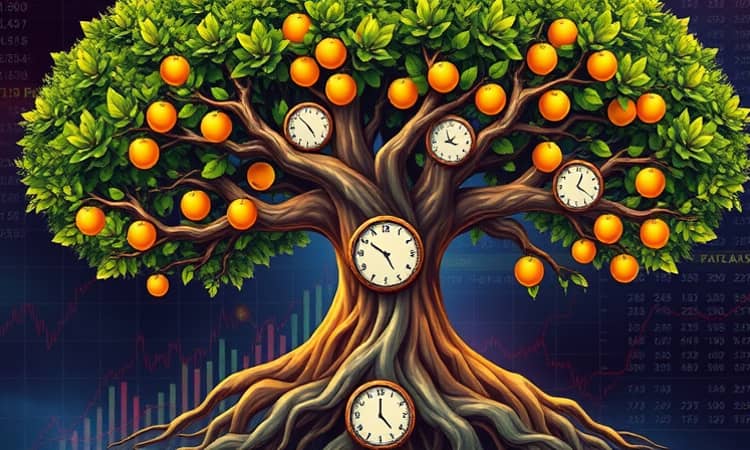
In a fast-paced world that celebrates instant results, long-term investing often feels countercultural. Yet, the most enduring fortunes are rarely built overnight. This article explores why patience is not just a virtue but a critical asset for any investor.
We will journey through historical data, psychological insights, and practical strategies to show how staying the course can transform modest sums into lasting wealth.
Definition and Essence of Long-Term Investing
Long-term investing involves holding assets such as stocks, bonds, or real estate for periods of five years or more, focusing on gradual accumulation rather than immediate gains. It requires steady wealth accumulation over decades and a commitment to weathering market cycles without succumbing to impulse.
This approach contrasts sharply with active trading or market timing, where frequent transactions aim to capitalize on short-lived price movements. Instead, patient investors trust in the fundamental strength of their holdings and the natural power of markets to reward perseverance.
Core Benefits of Long-Term Investing
- Exponential growth over time horizons: Through compounding, returns generate their own earnings, creating a snowball effect that accelerates wealth accumulation.
- Historical outperformance against benchmarks: Over the last century, major indices like the S&P 500 have delivered annualized returns exceeding 10%, demonstrating the market’s long-term upward trajectory.
- Narrowed return ranges after decades: While short-term returns can oscillate wildly, holding positions for 20 or 30 years compresses outcomes into consistently positive results.
- Reduced transaction and tax burdens: Fewer trades mean lower fees and minimized capital gains taxes, allowing investors to reinvest more deeply.
- Avoiding costly emotional investment decisions: Distance from daily market noise shields investors from fear and greed, preventing panic selling and ill-timed purchases.
Each of these benefits hinges on a simple yet profound principle: time in the market is more valuable than timing the market. Historical data confirms that missing just a handful of the best days can dramatically erode returns.
Consider the S&P 500’s performance over various spans: in any 10-year window over the past eight decades, returns were positive 100% of the time, reinforcing the wisdom of a patient, unwavering approach.
Psychological Dimension: Harnessing Patience
Investing success is as much about mindset as it is about numbers. Behavioral finance teaches us that emotions drive many market movements. By cultivating patience, investors can turn volatility into opportunity rather than a trigger for regrettable decisions.
Fearless patience shields you from fear when markets plunge and embrace volatility as a wealth ally when prices dip. Viewing downturns as chances to add quality assets at discounted prices reframes short-term losses into the foundation for future gains.
Legendary investors often cite psychological resilience as their greatest edge. It is not selectivity or timing, but the discipline to stay invested that separates the outliers from the pack.
Time in the Market vs. Timing the Market
Debates about timing versus staying invested are longstanding. However, research shows that attempts to jump in and out of the market almost always underperform a steady, long-term allocation.
Over the past twenty years, if an investor missed the ten best days in the S&P 500, their compound annual growth rate would drop from roughly 9.8% to 5.6%. Missing the thirty best days would nearly erase all gains. Such data underscores the peril of market timing.
Consistent long-term exposure beats timing every time, providing the clarity needed to resist lures of quick profits and short-lived tips.
Strategies for Patient Investors
Embracing a patient approach requires concrete tactics. Below are some key methods to build and sustain a long-term portfolio:
- Diversification spreads risk and opportunity across asset classes, smoothing the impact of any single underperforming investment.
- Dollar-cost averaging builds positions over time by investing fixed amounts at regular intervals, reducing sensitivity to market swings.
- Reinvesting dividends fuels the compounding machine by converting payouts into additional shares without hesitation.
These strategies, when applied consistently, reinforce the discipline to avoid reactionary moves and stay focused on long-term objectives.
Putting Theory into Practice
To illustrate how patient investing compounds over decades, consider the following table of historical real returns, adjusted for inflation, across typical investment horizons:
Notice how inflation-adjusted returns remain robust, even in shorter spans, affirming that patient capital deployment over various cycles has historically preserved and grown purchasing power.
Take the example of reinvesting $10,000 at a 7% annualized real return. After 30 years, the fund value would surpass $76,000, whereas left in cash it would shrink in real terms due to inflation.
Case Studies: Wisdom from Veteran Investors
Warren Buffett, often dubbed the Oracle of Omaha, epitomizes long-term thinking. By acquiring quality businesses and holding them for decades, his holdings have multiplied beyond estimates.
Sir John Templeton, another pioneer, scoured global markets for undervalued securities and maintained his positions through market storms, demonstrating that patient exposure across geographies yields superior risk-adjusted returns.
Conclusion: Embrace Patience and Perseverance
Long-term investing is not a passive exercise in waiting; it is an active commitment to a philosophy backed by data, psychology, and real-world examples. By combining compounding returns generate future returns with disciplined strategies, investors can transform modest sums into life-changing wealth.
The markets will always present challenges and temptations to deviate. Yet, history favors those who remain patient, diversify effectively, and reinvest consistently. Let your patience be your greatest investment, and time your most valuable ally.